Blog
Hire Me:
I'll Bring Enough for the Whole Class (Action).
Twelve attorneys general already have Mariner Finance in discovery. Virginia is not among them, but may actually have a stronger case.
If you got a check from Mariner Finance in the mail, the company’s own blog still tells you to congratulate yourself. As of April 9, 2026, the pitch is unchanged: the check is real, it is a loan offer, and you cash it. “[N]o lines. No waiting.” Cashing or depositing “constitutes a loan transaction that you will be obligated to repay.” There is a 15-day satisfaction guarantee if you bring cash or certified funds back in time. If you are not interested, “please destroy it.”
That is not a teaser. That is origination. The attorneys general who sued Mariner in 2022 alleged that the company acquires half of its customers this way, mailing unsolicited live checks after a credit-bureau prescreen, and that the check is a foot in the door to a larger branch refinance packed with add-on insurance. I reconstructed a 2023 Virginia Loan-by-Mail contract from consumer-defense work. Borrower identifiers are omitted here. The form number is VA3510. The economics are specific, and they are the reason this is the matter I would walk into a plaintiff-side firm with.
Why this one
A hiring conversation is not a writing contest. A firm is deciding whether to put years and six figures of working capital behind a person. The honest version of “I bring cases” is not that I own a book of clients, or that anyone I used to represent would follow me. It is that I have already done the part that usually burns the first year: found the standardized practice, separated it from the case everyone else is already litigating, pressure-tested the statute, and mapped the vehicle that survives scrutiny.
Mariner is that file. The defendant is collectible. The product is still in the mail. A coalition of states has already survived a motion to dismiss and is in discovery in the Eastern District of Pennsylvania. One plaintiff state has already taken an $11.1 million consent judgment. And the claim I actually developed is not a copy of that complaint.
What the attorneys general already occupy
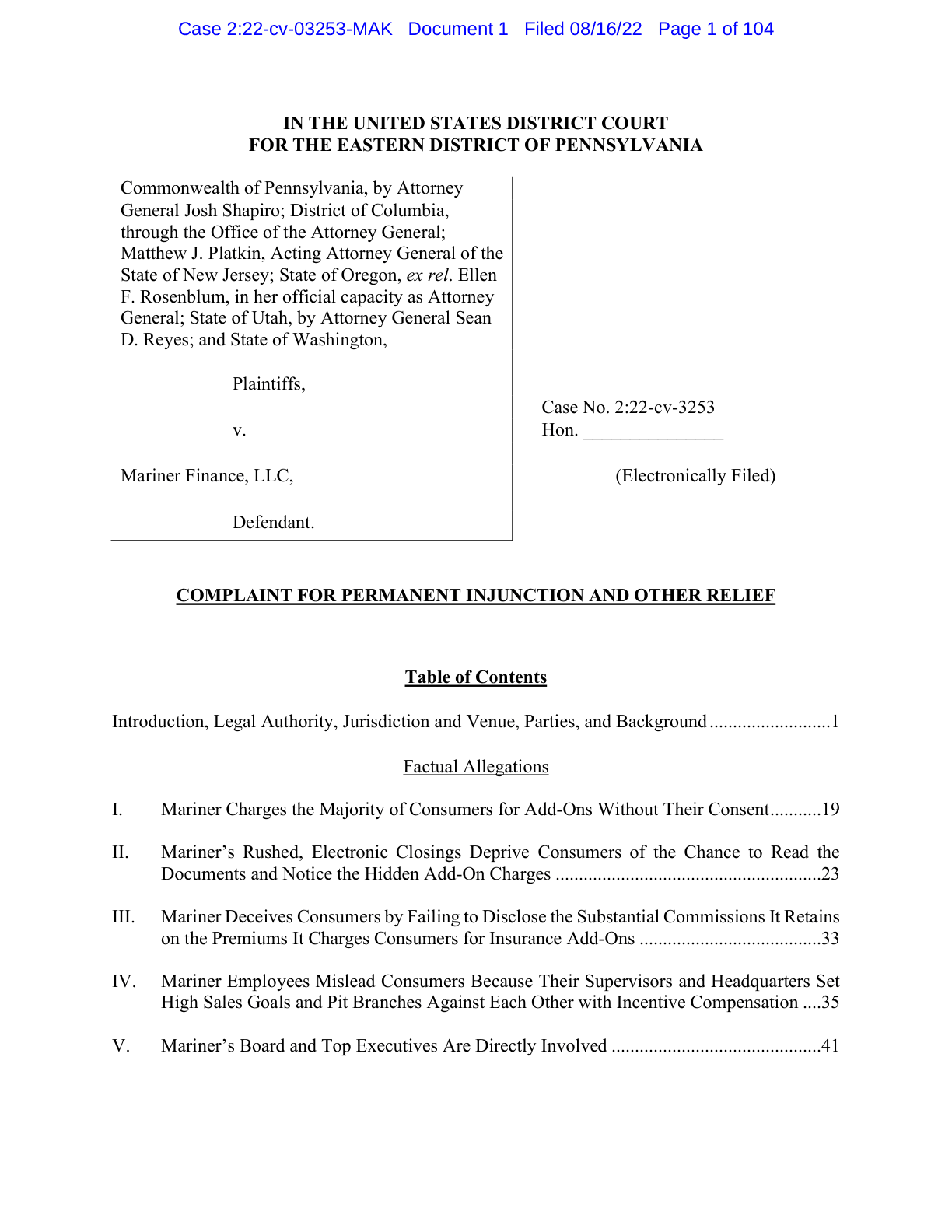
On August 16, 2022, Pennsylvania, the District of Columbia, New Jersey, Oregon, Utah, and Washington sued Mariner Finance, LLC in Commonwealth of Pennsylvania et al. v. Mariner Finance, LLC, No. 2:22-cv-03253 (E.D. Pa.). The live caption is before Judge Kelley Brisbon Hodge. The original complaint is on RECAP. Illinois, Indiana, New York, North Carolina, Tennessee, and Wisconsin later joined. Utah dropped from the second amended complaint caption. Virginia has never been a plaintiff.
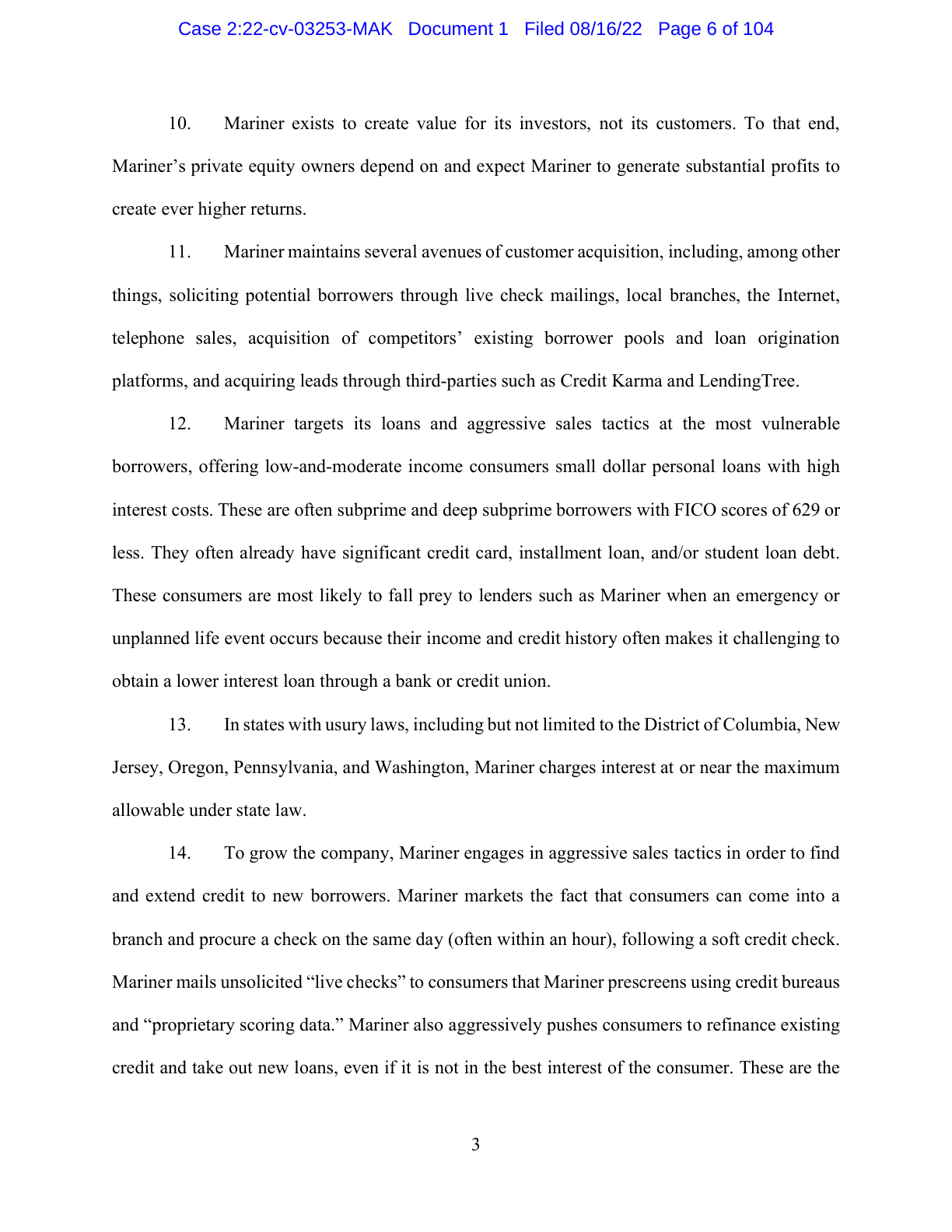
Mariner acquires half of its customers with its Loan by Mail (LBM) program, using prescreening of consumer files from a consumer reporting agency. Mariner mails live checks made out in targeted consumers’ names, with loan terms on the back. If a consumer or someone who intercepts the consumer’s mail cashes an LBM check, Mariner opens a loan in the consumer’s name.
The theory those states pleaded is add-on packing: credit insurance, AD&D, motor club, and similar products allegedly sold without real consent, in rushed e-closings, with employee commissions the AGs say ran as high as 75% of premium. The second amended complaint alleges that in 2019 Mariner charged consumers $121.7 million nationwide in add-on premiums and fees; that the 2020 average was $364 per loan, excluding interest; and that in May 2020 the company forecast $51.9 million in insurance income for 2022. Those are complaint allegations, not findings. Mariner has not admitted them. A court denied the motion to dismiss. Discovery is still open. Expert reports in that case are not due until 2027.
New Jersey’s 2022 press release put the growth story in one paragraph: Warburg Pincus ownership; 57 branches in seven states at acquisition; more than 480 branches in 27 states and more than $2 billion in loans managed as of that filing. Mariner’s own Tennessee settlement announcement (May 8, 2026) says the company “responsibly serves more than 700,000 Americans” and that the Tennessee deal “does not find any wrongdoing.” The consent judgment as described in the public motion is $11.1 million in consumer redress for that state alone—$1 million restitution plus $10.1 million in debt cancellation—plus fees. The other plaintiff states continue.
That is validation, not a vacancy. A private add-on class that simply restates the AG complaint would be late, arbitration-prone, and at risk of a release. I would not bring that case. I would bring the Virginia form.
What the Virginia contract actually does
The reconstructed 2023 Virginia live-check contract is not an insurance-packing exemplar. There are no credit-life or motor-club lines on the four-page form I have. Using it as an add-on class representative would be a mistake. What it does show, in print, is a fee trick that does not depend on a branch closer’s pitch.
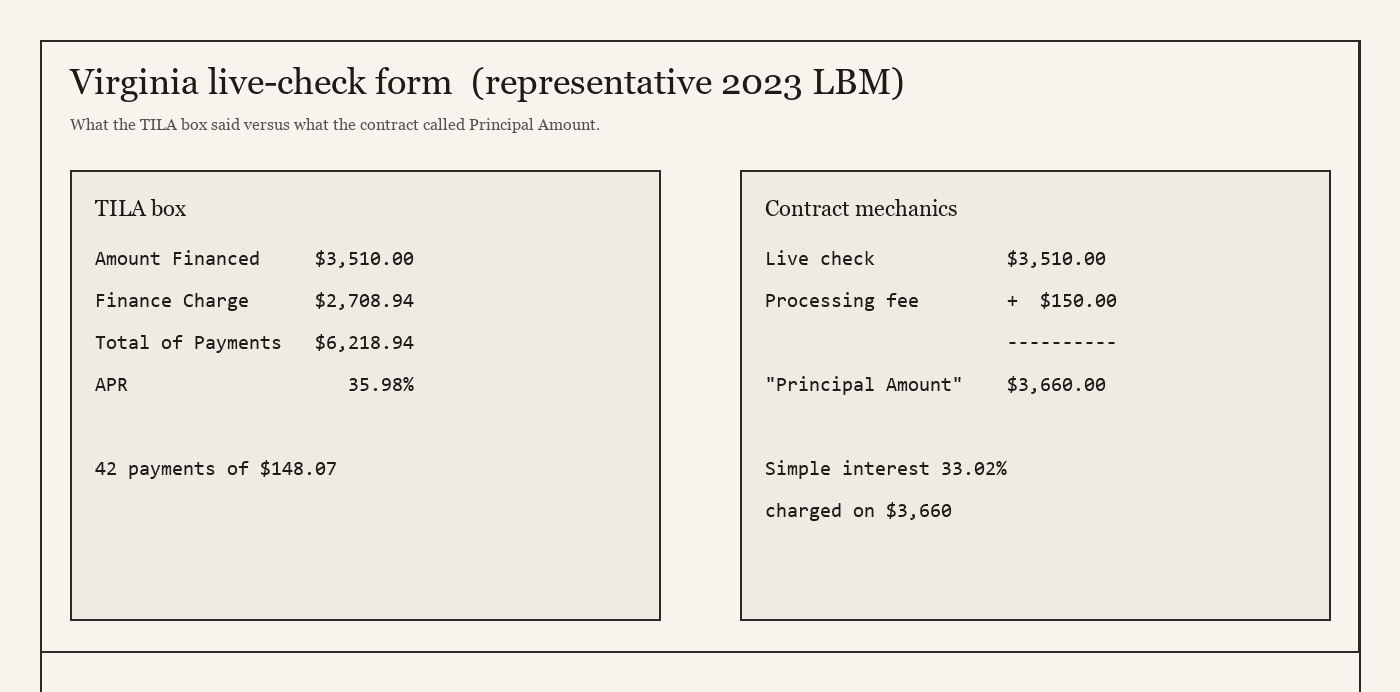
The live check was $3,510. The TILA box is clean on its face: APR 35.98%, finance charge $2,708.94, total of payments $6,218.94, forty-two payments of $148.07. Then the contract does the work the box does not emphasize. Amount Financed plus a $150 processing fee becomes the interest-bearing “Principal Amount.” Interest is 33.02% simple, including after judgment, until a post-default step-down. Cashing the check is treated as agreement to a separate arbitration rider, form ARB405. The marketing letter on the same mailing advertised a 15-day satisfaction guarantee. The statute and the contract speak of a 30-day processing-fee rebate. Those are not the same clock.
If a $150 fee is lawful, rolling it into principal and charging more than 33% on it means the borrower does not pay $150 for processing. The borrower pays $150 plus a slice of the finance charge attributable to that extra principal. On this form, $150 is about 4.1% of the $3,660 “Principal Amount.” The same share of the $2,708.94 finance charge is about $111. The all-in cost of “a $150 fee” is then in the neighborhood of $261 on a single loan, before late fees, before default interest, and before anyone refinances the live check into a larger branch loan—the conversion the AG complaint says is the point of the product.
The statute fight, without the brochure version
Virginia licenses this product under Chapter 15 of Title 6.2. I pulled the current text from the Virginia Legislative Information System on August 14, 2026. Section 6.2-1520(A) caps contract interest at 36% and says interest “shall be computed and paid only as a percentage of the unpaid principal balance.” Section 6.2-1520(C) allows a loan processing fee “not to exceed the greater of $50 or six percent of the principal amount of the loan, provided that the loan processing fee shall in no event exceed $150.” The fee “shall be stated in the loan contract.” If the loan is paid in full within 30 days, most of the fee is rebated.
The loan processing fee shall not be deemed to constitute interest charged on the principal amount of the loan for purposes of determining whether the interest charged exceeds the 36 percent annual contract interest rate limitation imposed by subsection A.
That sentence is the defense. Mariner will say the General Assembly already decided the fee is not interest for the 36% test; the TILA box discloses the APR; $150 is the cap, they charged $150, case over. A serious plaintiff lawyer has to be able to say that out loud.
The plaintiff’s construction is narrower, and it is better. The question is not whether $150 of fee plus 33.02% on the check proceeds exceeds 36% APR. The TILA APR on this form is 35.98%. The question is whether charging interest on the fee itself means the borrower paid more than $150 for processing, in a chapter that then says, in § 6.2-1523, that “[i]n addition to the interest, late payment fees, and loan processing fee permitted under § 6.2-1520, no further or other amount whatsoever … shall be directly or indirectly charged, contracted for, collected, or received,” subject to listed exceptions that do not include “interest on the processing fee.” If that reading holds, § 6.2-1542 requires a refund of the unauthorized or excess charge actually received, and—unless it was a bona fide one-off computation error—a penalty of twice that amount, plus costs and fees.
There is a second, harder theory on the same file: the licensed entity on the note is Mariner Finance of Virginia, LLC (Virginia consumer-finance license CFI-114). Servicing ledgers and cover letters on the file I saw came from Mariner Finance, LLC, which is not on the Chapter 15 consumer-finance list and does hold a Virginia mortgage-broker license. Section 6.2-1501(F) makes a loan made in violation of the licensing section void. I would not lead with void-the-loan. Affiliate servicing is common, and overclaiming “Mariner has no Virginia license” is how you lose credibility. The cleaner entity point is the one the documents actually support: the wrong Mariner is on the ledger for a Chapter 15 consumer loan. That matters for who can collect, who is a debt collector, and who has to answer discovery.
Layer the Virginia Consumer Protection Act on the disclosure mismatch—Amount Financed $3,510 versus interest-bearing principal $3,660; marketing 15 days versus contract 30—and § 59.1-204 supplies a $500 floor, treble if willful, and fees. TILA remains in the mix if the “Amount Financed” is the wrong legal number. None of that is filing-ready authority work. It is the issue list I would hand a firm on day one, with the official statute text already pulled.
Damages without the fantasy spreadsheet
Per-loan numbers on the reconstructed form, if the processing-fee construction holds and a trier treats the extra interest as an excess charge actually received:
Check / Amount Financed                  $3,510.00
Processing fee capitalized                 150.00
Contract “Principal Amount”              $3,660.00
Finance charge (TILA box)                $2,708.94
Fee’s share of principal                 150 / 3,660  ≈  4.10%
Fee’s share of finance charge            ≈ $111
Fee + interest on the fee                ≈ $261 per loan

Va. Code § 6.2-1542(B) (if willful / not a one-off math error)
  twice the excess actually received     ≈ $522  (plus fees)

Va. Code § 59.1-204(A)
  $500 statutory floor, or treble actual
  willful cap                            $1,000 or 3× actual, whichever greater
That is not a class-size model. I do not have Mariner’s Virginia live-check origination count, and I will not invent one. What I do have is the company’s own scale, the AG allegation that half of customers come in through LBM, and a demonstrated willingness to write an eight-figure check to exit one plaintiff state on a different theory. Tennessee’s $11.1 million was add-on redress, not processing-fee interest, and it came with no admission. It still answers the collectibility question that kills most consumer ideas before they start.
Even a conservative private inventory—Virginia live-check borrowers on VA3510, fee capitalized, no need to prove a hidden insurance pitch—produces a formulaic per-person number a firm can underwrite. A few hundred dollars of statutory and excess-charge recovery, times a four-digit or five-digit Virginia LBM book, plus fees, is how this covers the cost of the lawyer who found it. The upside is larger if void-loan or VCPA trebling attaches, or if packed add-on borrowers appear in the same inventory. The reconstructed form in front of me is the wrong named plaintiff for packing. The next step is to find the Virginians who have both.
How you actually try this
Not as a nationwide Rule 23 class filed tomorrow. Mariner’s notes elect AAA arbitration and waive class treatment. Harris v. Mariner Finance LLC, No. 3:18-cv-00588 (E.D. Va. 2019), compelled arbitration. Birmingham v. Mariner Finance, LLC, No. 3:23-cv-00272 (E.D. Va.), stipulated to a compel order and later dismissed with prejudice—an individual FDCPA/repo case, not a merits loss on live checks. The Maryland Hale class on refinance charges settled years ago and does not clear 2023 Virginia LBM borrowers.
The paths that survive that landscape are the ones I would sell:
Coordinated Virginia general-district-court counterclaims. Mariner already sues on these notes in GDC. Many arbitration clauses have a small-claims carve-out; Mariner has used court when it wanted to. A uniform-form excess-charge counterclaim, filed where Mariner chose the forum, is how you get a book without pretending the Fourth Circuit is going to certify a national add-on class next spring.
Non-signatory live-check identity theft. Cole v. Mariner Finance, LLC, No. 3:22-cv-00440 (W.D. Ky.), denied a motion to compel arbitration where Mariner could not show the plaintiff signed. The AG complaint itself pleads stolen-check and mailbox-theft complaints. That is a different named-plaintiff profile from the person who cashed the check and made payments.
Do not race the AG add-on case. Use it. The docket is public. The packing theory is occupied. Virginia is open. A firm that hires the investigation gets a map of what is taken and what is not, instead of a surprise release eighteen months in.
What a firm is actually buying
The work product is the reconstructed VA3510 economics, the CFI-114 versus Mariner Finance, LLC servicing split, the 15-day versus 30-day mismatch, the current Chapter 15 text, the AG occupancy map, and a vehicle recommendation that does not require pretending arbitration does not exist. I also know what not to say. A clean live-check form is not a packing exemplar. A 897-page Virginia “Statement of Change” that looks like a corporate history is a statewide registered-agent address dump. Mariner Finance, LLC’s mortgage-broker license is not a Chapter 15 consumer-finance license, and it is not “no license.” 2025 WebBank-originated online loans are a different defendant set.
I cannot ethically tell a firm it would inherit a particular consumer or a transferable claimant list. What I can tell a firm is that the expensive part of case development on this product—the part that is usually a year of associate time and a pile of dead ends—is already done, on a defendant that is still mailing the checks, still in AG discovery, and already proven willing to pay eight figures to resolve a single state’s piece of a related fight.
That is the case. The next sixty days of work, if a firm wanted it, are unromantic and decisive: pull the actual ARB405 rider, count other VA3510s, get the official origination-volume question into a CID or a public-records request, and read the Tennessee consent judgment against a Virginia release analysis. None of that requires reinventing the theory.
Independent analysis of public court records, official Virginia Code text retrieved August 14, 2026 from LIS, company and attorney-general publications, and a reconstructed, redacted 2023 Virginia live-check form. Not legal advice. Not a solicitation of clients. No attorney-client relationship is created by this article. I do not represent the attorneys general, Mariner, or any person whose loan is described. Complaint allegations are allegations. Mariner has denied wrongdoing in the Tennessee settlement announcement. This is not filing-ready and is not a citator-validated brief.